Queue a support note
Ask Clef AI whether a message is urgent, which named team owns it, and how severe it is.

Clef AI is the pair of decision models Cloudflare shipped on 1 October 2026. The larger model is 27B and is hosted as @cf/cloudflare/clef. Clef-flash is 9B and is hosted as @cf/cloudflare/clef-flash. You send a state and up to 64 typed questions. Clef AI returns a probability for each allowed answer, not an essay and not a tool-call transcript.
Official website · developers.cloudflare.com
A NavHunt schematic of the documented Clef AI request. It is not a product screenshot and not a benchmark chart. Source ↗
Clef AI fits a closed choice: which queue, which severity, or whether yes is likely enough to continue. It is the wrong tool for new wording or a decision a person must own. Weights do not make hosted inference free, and the local helper is not the hosted request.
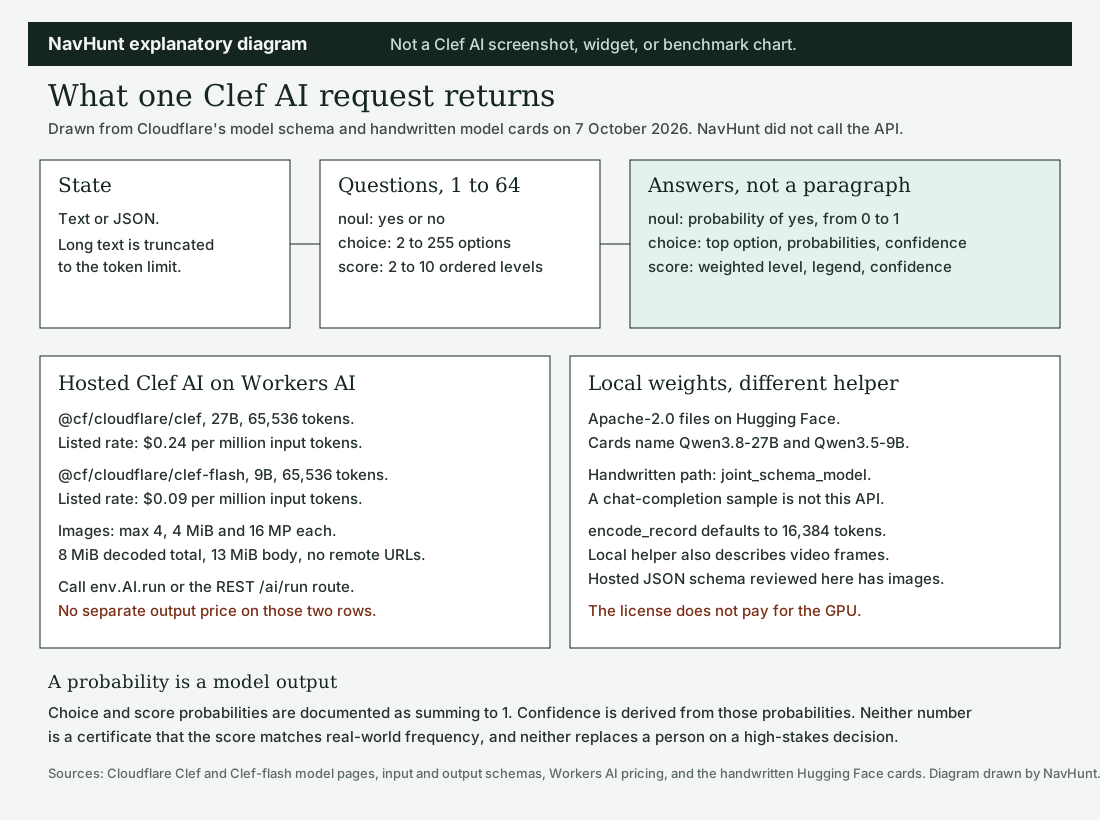
The 1 October changelog describes Clef AI as a decision model in Jev's family. It returns a probability for every allowed answer, not a paragraph. A Text Generation label, or the card tag image-text-to-text, can show a chat box. That box is not the schema.
The hosted body is model, state, and 1 to 64 questions. model is clef or clef-flash and must match the id you called. state is text or JSON. Ids may use letters, digits, underscore, dot, and hyphen.
Noul is the probability of yes, from 0 to 1, with no confidence field. Choice has 2 to 255 options and returns the top option, probabilities, and confidence. Score has 2 to 10 levels and returns a weighted score, a legend, probabilities, and confidence. Those probabilities sum to 1. Confidence is derived from them.
Official documentationCloudflare points the 27B model at precision and Clef-flash, the 9B model, at latency. Both hosted pages list 65,536 tokens. The cards name frozen Qwen/Qwen3.8-27B and Qwen/Qwen3.5-9B bases plus a joint scoring head. Rank-256 adapters and a Brier loss are training details, not a promise that a live score is calibrated.
Call env.AI.run or POST /ai/run. Instructions are required. Up to four embedded PNG, JPEG, or WebP images are allowed, not remote URLs, at 4 MiB and 16 megapixels each, 8 MiB decoded in total, inside a 13 MiB body.
The model page mentions video, but the hosted schema has no videos field. The card's local helper adds video frames, optional instructions, and a 16,384-token default. A chat sample matches neither body.
Official documentationCloudflare's support example asks Clef AI about urgency, team, and severity in one call. A score should not close an account alone. Clef AI does not fetch an image URL. The launch post by Michelle Chen, Alex Reneau, and Kevin Flansburg includes a vendor table against Jev. This page does not rank those models.
Official documentationAsk Clef AI whether a message is urgent, which named team owns it, and how severe it is.
Before a tool runs, ask Clef AI one yes-or-no question and attach up to four embedded images. A page URL is not accepted. The probability is not permission.
One JSON refund can carry several questions in a single Clef AI call, up to 64. You still write every allowed answer. Missing criteria are not invented.
If you need a paragraph, Clef AI is the wrong call. If every answer is listed, use noul, choice, or score.
Use a Workers AI id for the 65,536-token window, or the weight repo only if you will run the helper yourself.
Pass model, state, and questions. Embed PNG, JPEG, or WebP bytes only. Ignore a generic chat snippet.
Compare the probability with a threshold you chose. Keep a person on safety, money, and access decisions.
Clef AI has no confirmed Free, Pro, or Enterprise ladder of its own. The figures are unit rates from the Workers AI table updated 1 October 2026 and re-read on 7 October 2026. NavHunt did not buy a subscription.
Hosted calls to @cf/cloudflare/clef
$0.24
per million input tokens
Hosted calls to @cf/cloudflare/clef-flash
$0.09
per million input tokens
Run the card helper on your own hardware
$0
Apache-2.0 license fee
Workers AI also lists $0.011 per 1,000 Neurons. Times 21,818 and 8,182, that matches the token prices, so the columns are one charge. Free and Paid plans share 10,000 Neurons a day. Beyond that, Workers Paid is required. NavHunt's division is about 458,000 input tokens for the 27B model and 1.22 million for Clef-flash. The pool is not reserved for Clef AI, and no call proved these models draw it down. output_tokens is still in the schema. A missing output price does not prove output is free. The blog's no-training claim was not audited. Fine-tuning has no public date or price.
No. Clef AI returns probabilities for questions you wrote. Noul is one number, choice names the top option, and score is a weighted level rather than a paragraph. A hub chat box follows the generic pipeline tag. The card says to load joint_schema_model and score a record.
SourceHosted calls use the model page and the two schemas: model, state, questions, and optional images. Weights use load_release_model and the systemone helper on the handwritten card. An automatic chat sample is neither. The local helper documents videos and optional instructions. The hosted schema read on 7 October 2026 does not.
SourceCloudflare aims the 27B model at precision and Clef-flash at latency. Both hosted pages list 65,536 tokens and the same question types, at $0.24 and $0.09 per million input tokens. The cards name Qwen/Qwen3.8-27B and Qwen/Qwen3.5-9B, and both base cards mark Apache-2.0. NavHunt did not measure speed or copy a finer parameter count.
SourceNo. Values sit between 0 and 1, and choice and score probabilities sum to 1. Confidence is derived from those probabilities, not from your own outcomes. A training loss does not make 0.95 a measured hit rate. Do not let Clef AI replace a person on a hard-to-undo decision.
SourceChange the endpoint and model name, and keep state plus the three question types. Hosted images are an added field. The local helper can map that body on your machine. The blog calls Jev text-only at 32K and prints scores. NavHunt did not check those limits or rerun them, so Clef AI is described here only at the API layer.
SourceNo. The weight file is Apache-2.0, following the named Qwen base. Workers AI still lists input rates, and a Neuron pool is platform policy, not part of that license. Hardware you run is also outside it. A zero license fee is not a zero bill.
SourceNot in the schema read on 7 October 2026. Hosted images are embedded PNG, JPEG, or WebP, at most four, 4 MiB and 16 megapixels each, 8 MiB decoded in total, inside a 13 MiB body. Remote URLs are refused. Video frames are described only for the local helper. The model page mentions video in prose, so the page and the schema disagree until a hosted videos field exists. Do not send a video URL to the REST route.
SourceOct 7, 2026 · NavHunt editorial
Changelog, blog, model pages, schemas, pricing, both cards, the Apache file, and Qwen license metadata were read on 7 October 2026. No API call or benchmark rerun. Canonical URL: https://navhunt.com/products/clef. The image is an original NavHunt explanatory diagram.
Start from the Workers AI model page or the handwritten weight card. NavHunt does not proxy this model.