One person collecting notes
One operator, one Dot that may read public pages, and another that may revise a brief. Ask for a draft, use the review card, then edit the page.

OpenDots is the specialist-coworker template CopilotKit announced on 1 October 2026. You host the app, assign each Dot a role, and keep documents in Spaces and Pages. Chat is separate: every conversation requires CopilotKit Intelligence, hosted, evaluated locally in Docker, or self-hosted under a license.
Official website · www.copilotkit.ai
A NavHunt schematic of the OpenDots storage split and the connection that starts on. Source ↗
OpenDots fits someone who will edit a single-owner workspace and operate its dependencies. It is a poor fit for a managed coworker or a stack whose only cost is the MIT license.
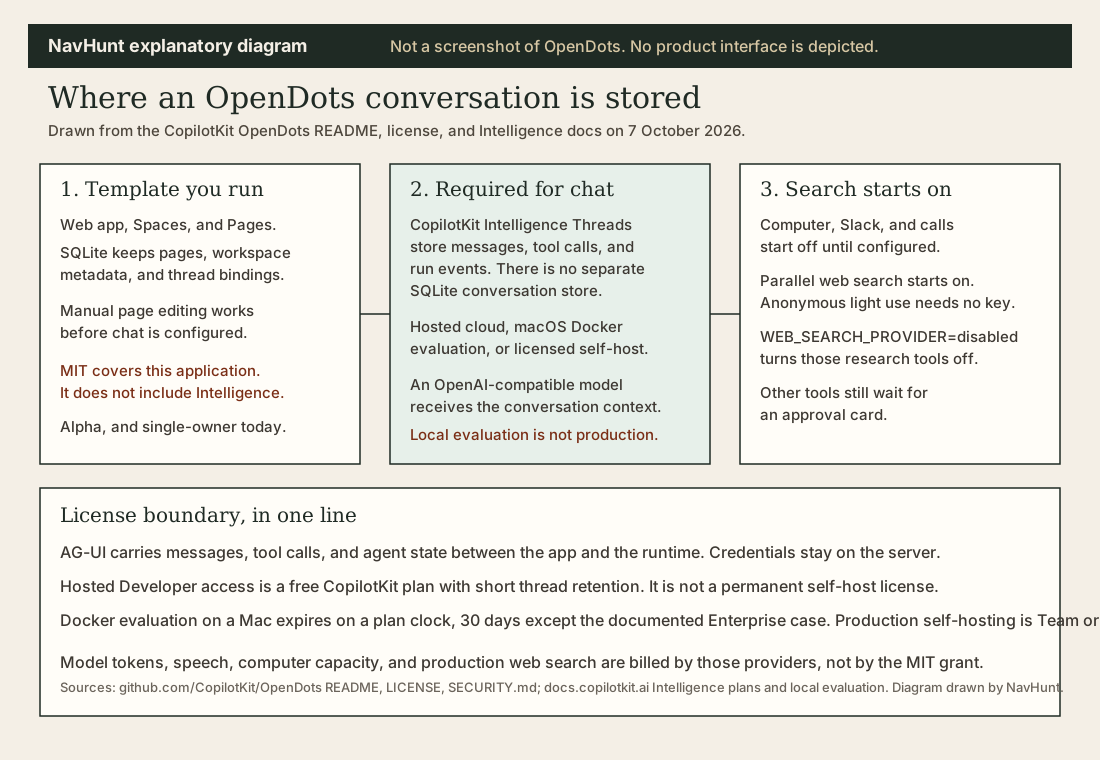
The product page and README call OpenDots an alpha template, not a hosted product. The 1 October 2026 post by Anmol Baranwal and Eli Berman presents it through AG-UI and an OpenAI-compatible model.
The LICENSE is MIT and names Atai Barkai. The vendored OpenBot file is MIT, copyright 2026 CopilotKit. Neither grant includes Intelligence or pays a model, speech, or computer bill.
The shell uses Node.js 24, copies .env.example, and serves 127.0.0.1:5173. Edit pages before connecting chat. Skip copilotkit onboard.
Official documentationA Space in OpenDots is a document home. Dots can reach more than one Space and have a default save destination. Pages have search, nesting, slash commands, and revision checks. A failed save keeps the draft.
Each Dot has a name, role, instructions, and tools. OpenDots does not run a group chat or hand work from one specialist to another.
Pages, metadata, and thread bindings stay in SQLite. Messages, tool calls, and run events go to the Intelligence deployment you choose: hosted cloud, local Docker evaluation, or licensed self-host. There is no second conversation database.
Official documentationThe launch post says computer access is off by default. OpenBot keeps that Dot's browser profile and files across restarts, with a separate credential. Service keys stay on the server. An unconfigured template does not run host commands.
Public-web research is separate. Parallel is the default for live research and Dot conversations, including anonymous light use without PARALLEL_API_KEY. It sends the query, requested URLs, a session id, and the objective. Set WEB_SEARCH_PROVIDER=disabled to turn those tools off. WEB_SEARCH_PROVIDER=browser keeps the older URL-only reader.
Calls need a speech provider. Slack is the documented channel, with an allowlist, not a finished Teams path. Read-only MCP tools run alone. Other tools wait for approval. A review card appears when you ask to see a draft first. The same draft retries onto one page. Page tools can still edit that Space.
Official documentationOne operator, one Dot that may read public pages, and another that may revise a brief. Ask for a draft, use the review card, then edit the page.
A recurring turn stays in the original conversation, with pause and retry. If the worker stops, OpenDots marks the run Interrupted until you retry it. Finished effects may remain. This is not an event system.
The prototype is single-owner. Shared editing, invitations, uploads, and embeds are absent. OpenDots is not described as a security-audited agent.
Conversations require Intelligence. Cloning OpenDots does not create that store.
Hosted cloud, macOS Docker evaluation, and licensed Kubernetes or AWS self-hosting are different permissions. Evaluation is not production.
Connect an OpenAI-compatible model. Leave the computer, Slack, and speech unconfigured until you need them. Parallel web search is already on. Set WEB_SEARCH_PROVIDER=disabled to turn it off.
The README dates page chat to 29 September 2026 and speech receipts to 30 September 2026. Local checks covered browsing, files, shell, and persistence. Slack and spoken handoff still need a connected-service test.
The OpenDots template has no license fee. Dollar amounts are CopilotKit Intelligence prices from the public page on 7 October 2026. Taxes are not shown.
Copy and modify the application
$0
MIT grant, no template fee
A first hosted conversation backend
$0
Hosted plan, one developer
A larger hosted thread allowance
$39
per month
The published team and self-host stage
$100
per seat per month, up to 5 seats
Enterprise is custom. NavHunt did not confirm a different $100 Team price for self-host checkout. Local evaluation needs macOS and Docker Desktop, refuses Colima, OrbStack, Rancher Desktop, and Windows, and asks for 4 CPUs, 12 GiB RAM, and 40 GiB free. Sign-in is required. Non-Enterprise licenses last 30 days. Plans in bad standing get none. After expiry, new Learning runs stop and old threads stay readable. The local stack includes threads, Automatic Learning, and Channels, not Intelligence User Memory or Product Analytics. OpenDots preferences are a separate switch. Model, speech, computer, and a production Parallel key cost extra. Web search is already on. Set WEB_SEARCH_PROVIDER=disabled to turn it off. Telemetry opt-outs are COPILOTKIT_TELEMETRY_DISABLED=true and DO_NOT_TRACK=1.
No. This page is only the CopilotKit template. The announcement names OpenAI Dots, which NavHunt did not review. Search on 7 October 2026 also found unrelated repos, swchoi1994/opendots and Shashankss1205/OpenDots. Their behavior is not part of this OpenDots page.
SourceNo. MIT covers the template. Chat needs Intelligence. Hosted Developer access is free only inside caps such as three-day retention. The Mac evaluation lasts 30 days on non-Enterprise plans and is not production. Kubernetes or AWS self-hosting needs a Team or Enterprise license. Offline running does not make that license permanent.
SourceAn Intelligence project and a model. Hosted setup writes CPK_INTELLIGENCE_API_KEY, then OPENAI_API_KEY and OPENAI_MODEL. Local evaluation writes a local API URL instead. The model still receives page text and tool results. A local Intelligence box does not make a remote model local, and the Learning model is separate. Local sign-in docs ask for Node.js 22 or newer. The OpenDots README asks for Node.js 24.
SourceMessages and run events go to the Intelligence deployment you chose, including local evaluation or licensed self-host. Pages and metadata stay in SQLite. Computer files stay in that Dot's workspace when a computer exists. Speech and Slack send data when used. Parallel sends the query, URLs, a session id, and the objective unless WEB_SEARCH_PROVIDER=disabled.
SourceSlack and spoken task handoff still needed a connected-service test. Learning can be configured locally, but cloud schedules, eligible-thread counts, and published-skill delivery needed the same test. Skills must be reviewed, and old conversations without a container are not enrolled later. The project says web and mobile are available. A path listing on 7 October 2026 found no mobile, iOS, or Android directory, so that claim was not tested here.
SourceNo. Use loopback locally, and authentication plus HTTPS if OpenDots is remote. Do not expose the browser-service port. Authorize every Space, Dot, and thread on the server, and do not trust a Slack display name. Voice credentials must be scoped and short-lived. There is no bounty or response-time promise. A schedule also needs the server to stay up.
SourceNo. Parallel is the default for live research and Dot conversations, including anonymous light use without PARALLEL_API_KEY. It sends the query, requested URLs, a session id, and the objective. Set WEB_SEARCH_PROVIDER=disabled to turn those tools off.
SourceOct 7, 2026 · NavHunt editorial
README, licenses, SECURITY.md, the 1 October 2026 announcement, the product page, and Intelligence pricing docs were read on 7 October 2026. NavHunt did not install or run OpenDots, repeat the connected-service checks, check out, or audit retention. Quoted test dates were not rerun. Canonical URL: https://navhunt.com/products/opendots. The image is an original NavHunt explanatory diagram, not a captured screen.
Use the repository README for setup. Chat needs an Intelligence deployment and an OpenAI-compatible model. The computer stays off until you enable it. Web search does not.